


Before the main story, here are some important happenings this week.
Enterprise AI is starting to show up in the numbers. Workday reported nearly 13% revenue growth and said more than half of its net-new customer wins bought at least one AI solution. After years of pilots and experimentation, the more important question is becoming whether customers will actually pay for AI and whether it changes the economics of the companies selling it. (Reuters)
Salesforce and Anthropic are bringing AI directly into everyday enterprise workflows. Their expanded partnership puts Salesforce capabilities inside Claude, including 37 pre-built sales skills that can work with customer data and take CRM actions. It’s another sign that AI may become less a standalone destination and more the interface through which people actually use enterprise software. (WSJ)
Chinese open-source AI models are gaining traction with U.S. businesses. Companies are increasingly experimenting with Chinese models as lower-cost alternatives to offerings from American AI leaders. While governments debate AI leadership and national competitiveness, businesses may increasingly choose models based on a simpler calculation: performance, flexibility and cost. (Fortune)
ChatGPT has become a real advertising business on scale. OpenAI says ChatGPT Ads has reached a $1 billion annualized revenue run rate and is expanding internationally. If consumers increasingly use conversational AI to discover, compare and decide what to buy, ChatGPT could become a meaningful new media channel alongside search, social and retail media. (ADWEEK)
Publishers are starting to create content for machines as well as people. USA Today Co. is experimenting with formats that make its journalism easier for AI systems to access, understand and cite. Marketers should pay attention because as AI becomes a discovery layer, brands may need to optimize content not just for people and search engines, but for the AI systems answering their customers’ questions. (Digiday)
Taken together, these developments show AI moving beyond experimentation and into the underlying economics and infrastructure of business, namely, what companies buy, how employees interact with software, which models businesses choose, how consumers discover products and even who or what content is created for.
AI Is Everywhere but the P&L
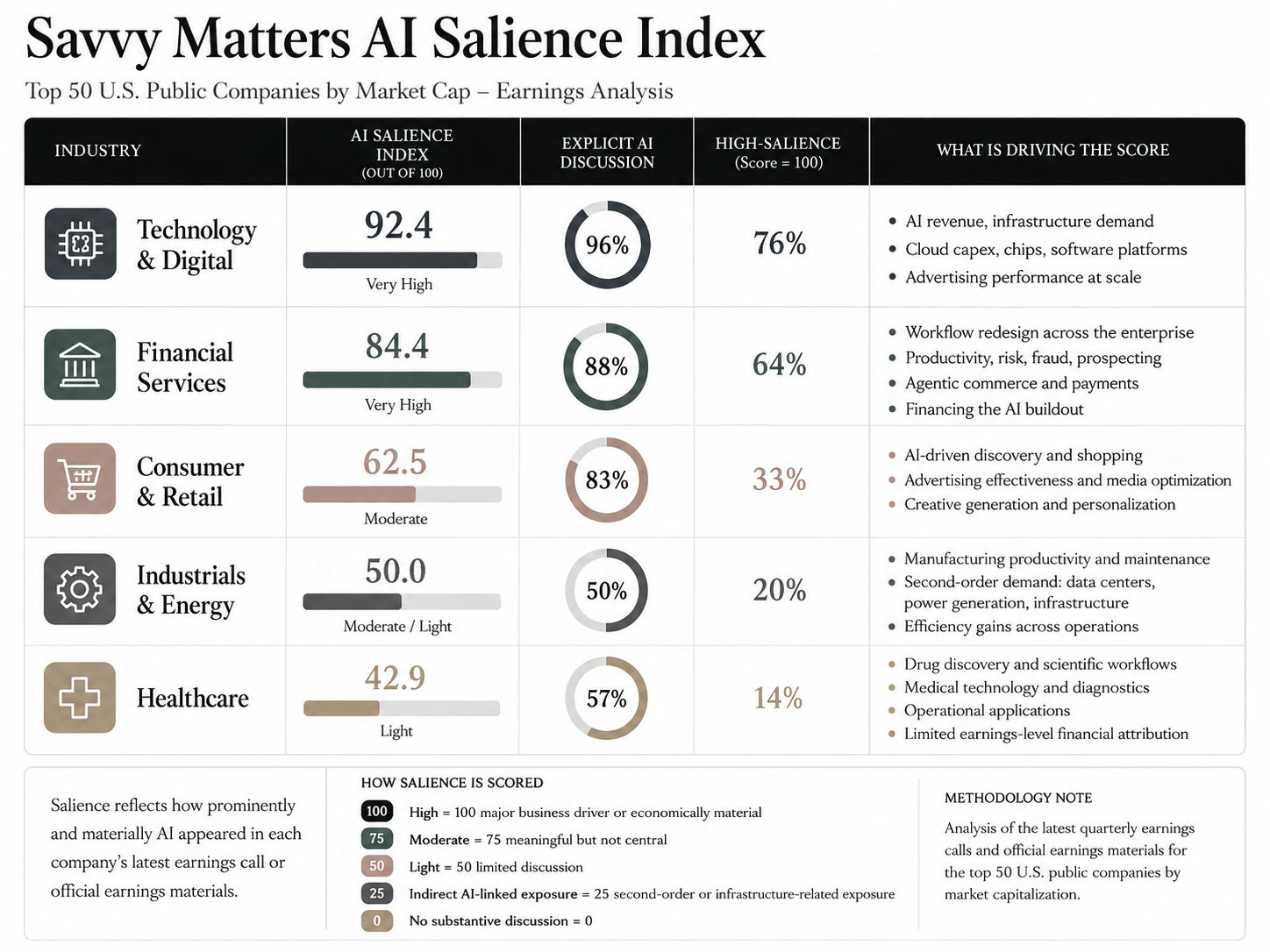
Eighty-two percent of the fifty largest U.S. public companies substantively discussed AI on their most recent earnings calls. Meanwhile, only 37% of respondents to McKinsey’s latest global survey say AI has made a positive contribution to their organization’s EBIT. The figures come from different populations, but the contrast captures the real story of enterprise AI in 2026.
I analyzed the latest earnings calls, prepared remarks and earnings materials for the fifty largest U.S. public companies by market capitalization. Rather than count mentions, I looked at whether management treated AI as a source of revenue, operating leverage, capital investment, customer growth, business-model change or risk. I then scored each company on an AI Earnings Salience Index out of 100.
Eighty-two percent cleared the bar for substantive discussion, while 60% treated AI as a high-salience earnings issue. Eighty-six percent either discussed AI directly or were materially benefiting from the infrastructure buildout around it. In other words, AI is already shaping the economics of nearly every major company, even when it is not yet producing a line item of its own.
Now set that against McKinsey’s State of AI in 2026, based on a survey of 1,719 respondents across 97 countries. Nearly nine in ten organizations regularly use AI in at least one function, and 44% say it is scaling across the enterprise. Eighty percent of respondents say AI has improved their personal productivity, and half say it helps them make better decisions. Yet just 37% report a contribution to EBIT, while only 6% qualify as high performers by attributing at least 5% of EBIT to AI.
Baseline adoption, then, is largely settled. Enterprise scaling and economic capture, on the other hand, are not.
Methodology note: The index measures the depth and economic specificity of management’s AI discussion across revenue, operating leverage, capital investment, customer growth, business-model change and risk. It is a directional measure of AI’s prominence in the investor narrative, not a ranking of realized financial performance. AI assisted in the analysis.
Where did the productivity go?
The most useful question in enterprise AI is no longer whether it can make people more productive. We know it can. The question is what the organization does with the time it saves.
Eighty percent of respondents report improved productivity, while 37% report an EBIT contribution. Both figures are probably accurate. Some of the saved time is producing better work, but too much is being reabsorbed into more meetings, more drafts, more analysis nobody asked for and more work expanding to fill the hours AI was supposed to free.
Individual productivity does not aggregate into economic performance on its own. It does so only when someone removes the step, handoff, review cycle, vendor expense or role that the saved time used to fund. That is an organizational decision, not a technology decision, and it is the decision most companies have quietly avoided so far.
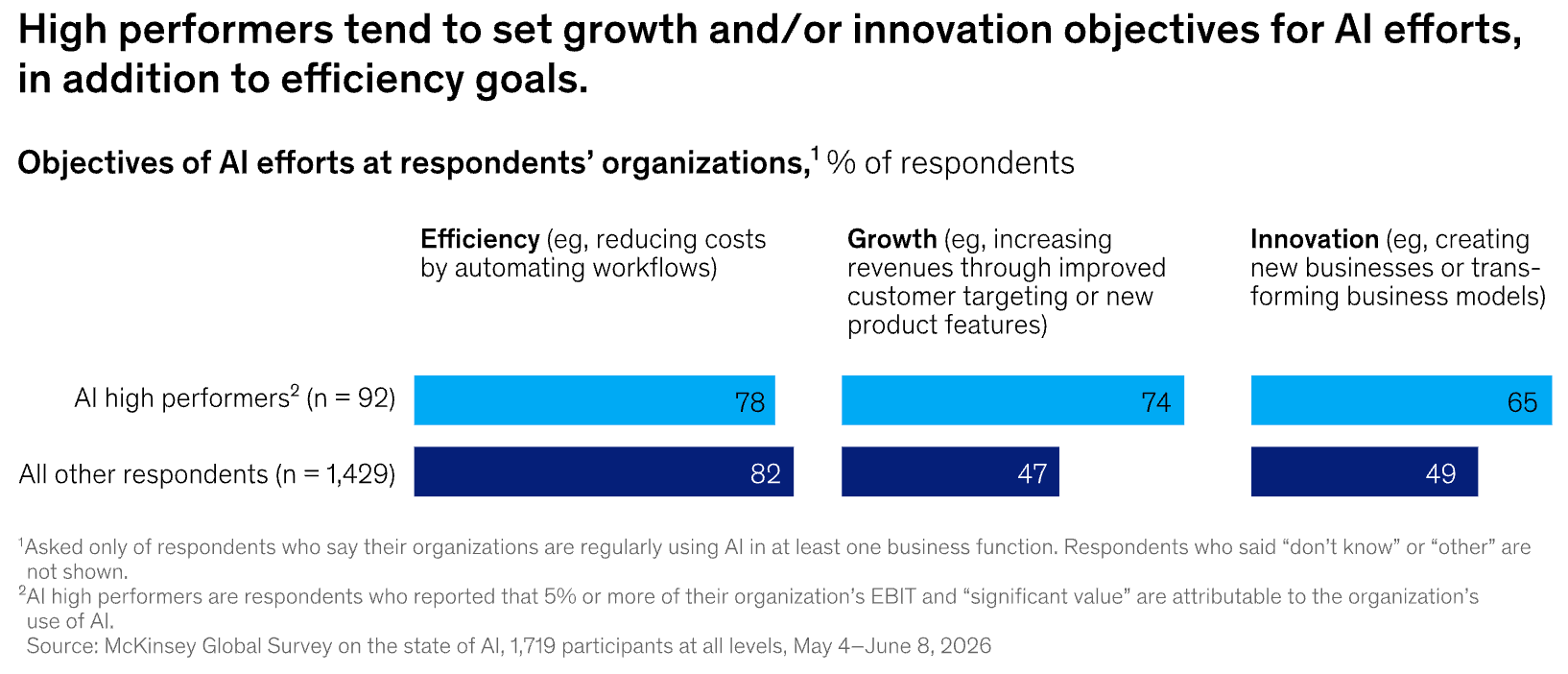
This is why the workflow finding in McKinsey’s data matters so much. Nearly three-quarters of AI high performers say they are fundamentally redesigning workflows around AI, compared with roughly a quarter of everyone else. The return does not come from adding AI to an existing process. It comes from being willing to delete or reconstruct the process itself.
GE Aerospace offers a useful contrast. It is embedding AI into its FLIGHT DECK operating system to improve supply-chain and manufacturing processes. That is very different from handing employees an assistant and hoping the hours appear somewhere. One changes how the work is structured. The other helps people move faster through work that may no longer need to exist.
The maturity curve runs from individual productivity to workflow transformation and, finally, to operating-model transformation. Most companies are stalled between the first two stages. As I have discussed here over the last year, the advantage sits in the third, and very few have reached it.
Three ways AI appears in the numbers
Three patterns in my analysis show how AI is entering the economic narrative. They are not equally instructive, but together they reveal how value is moving through the market.
The first group sells AI. NVIDIA’s data center revenue reached $89 billion in its latest quarter, while Broadcom, AMD, Micron, Oracle, Cisco and Dell can point to revenue, backlog, orders or capacity. For these companies, AI is not adjacent to the business model. It is the business model, which makes them fascinating to watch but harder for most enterprises to emulate.
The second group deploys AI at scale without selling it. Financial services scored 84 on the salience index, just behind technology at 92. Bank of America has roughly 200,000 employees using AI, including around 19,000 developers using coding assistance and reporting productivity gains above 20%. JPMorgan has described nearly a thousand use cases spanning risk, fraud, service, prospecting and marketing.
Those are impressive deployment figures, but they are still deployment figures. The question worth asking is which use cases moved a unit cost, cycle time or revenue line, and by how much. The distance between a thousand use cases and a thousand economic outcomes is the larger AI value gap in miniature.
The third group benefits from the second-order economics of AI. Caterpillar and GE Vernova do not sell AI, but both benefit from the data centers and power infrastructure it requires. Goldman Sachs sees financing opportunities in that buildout, while Chevron is exposed to the resulting energy demand. Semiconductors need servers. Servers need data centers. Data centers need electricity, cooling, land and construction. All of it needs capital.
Every company is therefore running two AI questions, although most are asking only one. The obvious question is how we use AI. The less obvious one is how everyone else’s use of AI changes our economics through new demand, intermediaries, input costs, profit pools and competitors. For a meaningful number of companies, the second question is worth more than the first and considerably cheaper to answer.
The marketing paradox
The finding I did not expect was in marketing. McKinsey identifies marketing and sales as the function in which companies most frequently report AI-related revenue gains. Yet among the top fifty companies, only about ten to twelve have a meaningful marketing-related AI narrative, and only a handful discuss it in depth.
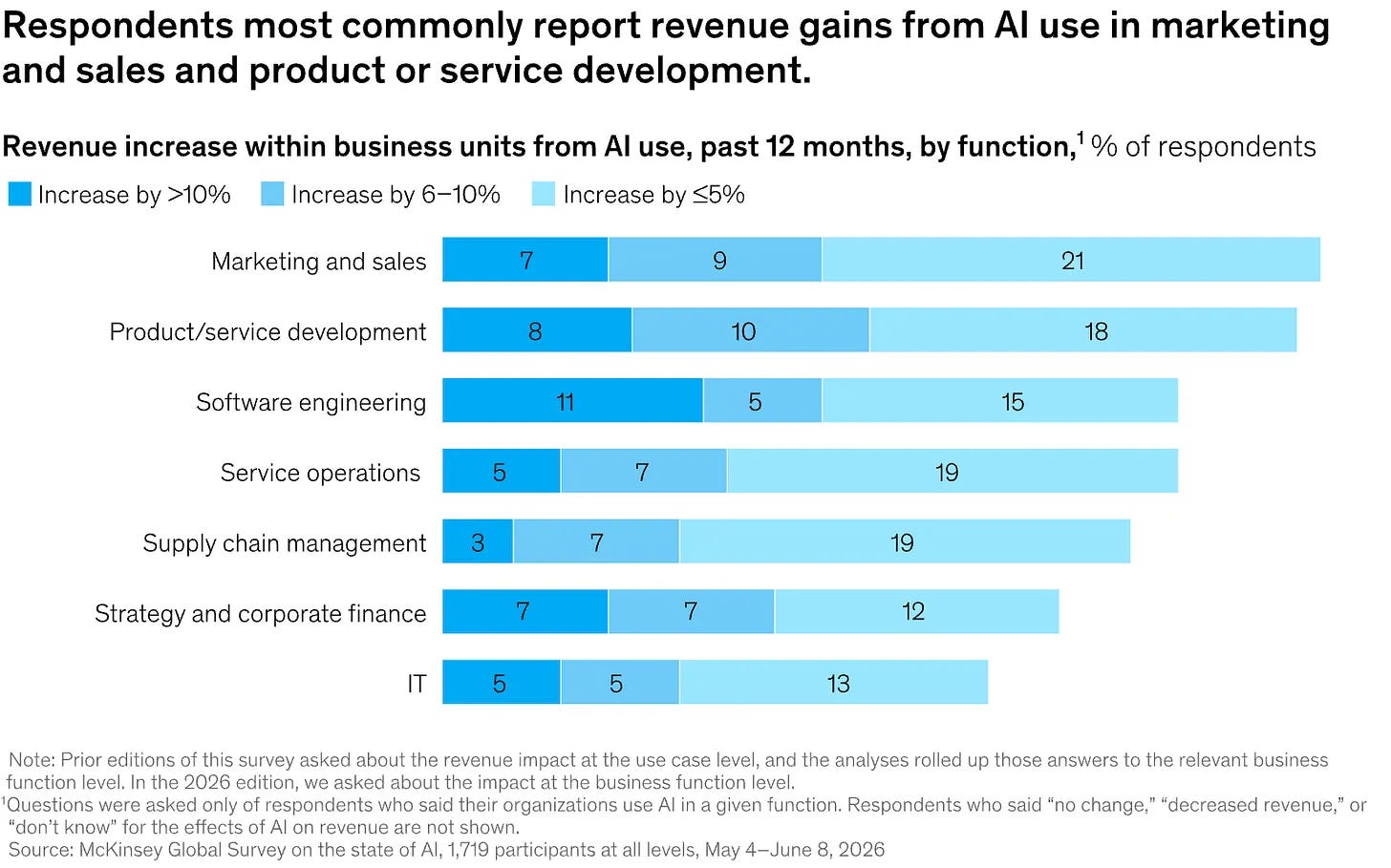
The function in which revenue impact is most frequently reported is among the least represented in the story management tells investors.
There are two possible explanations, and neither is comforting for marketers. Either the gains are real but CMOs are not translating them into the economic language that reaches an earnings call, or the gains are softer than the survey suggests because they sit in output volume rather than outcomes. In my experience, it is more of the first. Marketing has spent two years reporting content velocity, campaign counts and hours saved. None of that appears to have survived contact with the CFO and the broader investor narrative.
Five distinct narratives emerge from the transcripts. They show how rapidly AI is moving from a tool used by marketing to an interface that may reshape marketing itself.
AI makes existing advertising work better. Meta is the only company in the top fifty putting substantial numbers against this claim. It reported a 15.7% uplift in Facebook conversions associated with advances including its ads-ranking and sequence-learning systems, along with a 1% lift in Instagram app-event conversions from an LLM pilot. Advantage+ has reached a $75 billion annual revenue run rate, and more than nine million small businesses use at least one of Meta’s AI ad-creative tools.
Notice who is producing the evidence. The quantified case for AI in advertising comes from the seller, not the buyer. Meta can measure it because it owns the loop from creative to impression to conversion, while advertisers own fragments. Until a brand closes its own loop, it will keep buying outcomes it cannot independently attribute. That represents a durable transfer of leverage to the platform and remains one of the least discussed consequences of AI in marketing.
AI compresses the marketing workflow. P&G is the most instructive traditional marketer here. It has described integrating AI-enabled capabilities from creative development through media activation, continuously optimizing effectiveness rather than treating creative, media and measurement as sequential processes separated by handoffs.
This is the marketing version of the deletion test. Most organizations still run a relay in which teams brief, produce, hand work to media, activate, measure, learn and brief again. Every handoff costs time and loses information. AI does not merely make the relay faster. It can make the relay unnecessary, which is where marketing’s operating leverage will come from. Assets produced per week will never capture it.
AI changes discovery. Costco has discussed making its products discoverable inside major AI platforms as consumers increasingly use AI for product research. Home Depot’s Magic Apron answers project questions and shapes product selection, while Walmart’s Sparky has become part of the shopping journey. Customers who use Sparky spend 40% more per order than those who do not.
That does not prove Sparky caused the increase, but it does show that a commercially valuable customer interface is taking shape. Costco’s position is the quiet landmark here. A major retailer is effectively telling investors that the shelf is becoming a model’s answer.
AI changes commerce itself. Visa is exploring personalization and the emerging agentic ecosystem, while Mastercard’s Agent Pay is designed for commerce conducted by AI agents. If an agent discovers, evaluates and buys on a customer’s behalf, marketers are no longer persuading only a person. They must also be legible and preferable to the agent acting for that person. That rewards structured product data, verifiable claims and clean pricing in ways that a thirty-second spot does not.
AI becomes the customer interface. Meta has begun hinting at business agents that talk to customers, recommend products and feed intelligence back to the business. At that point, the brand’s front door is a model, and the model is not yours. The question is no longer simply how a company markets through an AI platform, but how much of the customer relationship it is willing to let that platform mediate.
Together, these narratives from the earnings calls describe three stages. The first is AI for marketing, which makes marketers faster and current advertising more effective. The second is AI inside marketing, which redesigns how creative, media, targeting, measurement and engagement fit together. The third is marketing to AI, where AI becomes an audience, intermediary or buyer in its own right.
Almost every marketing organization I talk to is optimizing the first stage. The third is already being built around them, as this quarter’s earnings calls make clear. If I were choosing three cases to study, I would pick Meta for the quantified economics of AI-powered advertising, P&G for its integrated AI-enabled marketing model, and Visa and Mastercard together for agent-mediated commerce. They span the full progression, yet very few brands are looking at them holistically.
Five things worth doing now
Replace your AI dashboard. If it shows seats, prompts, pilots and employees trained, it is an activity dashboard. Every core metric should map to something the CFO or CEO already tracks. A use case that cannot be connected to a recognized revenue, cost, margin or working-capital measure is still an experiment and should be labeled accordingly.
For every productivity claim, name what you removed. If a team says AI saved 20% of its time, ask whether that eliminated a review step, vendor, report, week of cycle time or future headcount plan. In marketing, begin with the seams between strategy, creative, media and measurement. If nobody can name what changed, the gain was donated back to the organization rather than captured.
Close your own measurement loop. Meta can quantify AI’s contribution while most advertisers cannot because it has the measurement architecture, not simply the better model. Until a company can attribute outcomes independently, every performance gain will be reported by the party selling the media rather than the buyer. That is platform dependence with a dashboard.
Answer the second AI question. Bring together a small group for one session focused entirely on how other companies’ AI adoption changes your demand, costs, channels and competitive set. Keep pilots, vendors and budgets out of the room. The companies that answered this question early are now sitting inside somebody else’s growth story.
Begin the legibility work before you need it. Structured product data, machine-readable claims, standardized brand language, consistent pricing and specification accuracy determine whether an agent can find, understand and represent you correctly. Costco and Mastercard are already treating this as an earnings-relevant issue. It will become a boardroom issue, and the work will take much longer than the meeting that authorizes it.
The meaningful divide in 2026 is no longer between companies that use AI and those that do not. That gap has largely closed. It is now between companies where AI appears on a slide and those where it appears in a line item or features meaningfully in an earnings call.
The second group is still small, but it will not stay small. Its advantage will compound while everyone else counts pilots.
Where I’ll be this fall
Join us at the AI Trailblazers Fall Summit at Rockefeller Center in New York on September 29 where you will learn more about what it takes to be an Intelligent Enterprise.
You’ll hear from peers including Raja Rajamannar of Mastercard, Stefanie Fried of McAfee, Amit Shah of Instalily, Jethro Ferguson of Haleon, Murari Gopalan of The Expedia Group, Kristin Deutmeyer of Heidrick & Struggles, and board directors from Edelman, Braze, Sunrun, and TrueBlue among others.
You’ll also be in the room with executive marketers from Anthropic, Citi, GEICO, Google, Kenvue, Mondelēz International, Novartis, OpenAI, PepsiCo, U.S. Bank, and other leading organizations. You can find more details and register here.

Here’s a snapshot of some of the public conferences where I’ll be speaking in the coming months, in addition to the company-specific training and consulting engagements that I do.
What I’ve written lately
The AI Advantage Is Faster Decisions (August 2026)
Companies Are Missing the Point of AI (August 2026)
Taste Is No Longer a Human Advantage (July 2026)
When AI Becomes the Referee (July 2026)
The Front Door Moves (July 2026)
Shiv Singh is the CEO of Savvy Matters, which helps business teams translate AI disruption into practical business and marketing strategies, organizational design, executive-ready roadmaps, and bespoke education programs. He is also the Co-Founder of AI Trailblazers, a vibrant community uniting marketers, technologists, entrepreneurs, and venture capitalists at the forefront of AI.
A former two-time Chief Marketing & Customer Experience Officer and author of Marketing with AI for Dummies (4th print run, translated into five languages), Shiv built his career at LendingTree, Visa, PepsiCo, and The Expedia Group, and serves as a public-company board member of a Fortune 300 company and private investor.