


We have just a few seats left for the AI Trailblazers Intelligence Summit in New York on September 29. Join 150+ senior leaders as we explore the future of AI in the enterprise, marketing and leadership. Register here: fall26.aitrailblazers.io
Before the main story, here are some important happenings this week.
The frontier-model price war is accelerating as OpenAI and Anthropic simultaneously improve capability while cutting deployment costs. OpenAI’s new GPT-6 Sol and Luna arrive with API pricing roughly 50% below their GPT-5.6 predecessors, while Claude Opus 5.5 is about 40% cheaper than Opus 5 on typical workloads. For enterprises, rapidly improving price/performance makes model selection increasingly dynamic and strengthens the case for scaling AI beyond pilots into high-volume workflows (OpenAI, Anthropic).
Meta is betting that personal AI’s next major interface may be glasses rather than another app. At Connect 2026, Meta announced it is bringing its Muse personal agent to AI glasses, alongside an expanded hardware lineup that it says will exceed 100 styles across Ray-Ban, Oakley and Meta Glasses by year-end. The broader strategic bet is that persistent, hands-free agents could become a new consumer computing layer—and potentially a new gateway to commerce, media and brand interactions (Meta Connect).
Microsoft is turning Copilot from an assistant into an operating layer for delegated knowledge work. The redesigned Microsoft Copilot introduces Home, Code and Autopilot, including persistent agents that can continue working when employees are away and tools for building internal solutions through natural language. The competitive question is moving from who has copilots to who can redesign workflows and governance around autonomous digital labor (Microsoft).
AI discovery is becoming AI commerce, putting the customer journey—and marketers’ control over it—up for renegotiation. Eligible Shopify merchants can now support purchases directly within Google AI Mode and Gemini through native AI checkout. Removing the traditional click-through to a merchant site could reduce purchase friction, while raising bigger questions for brands about attribution, first-party data and influence when the AI interface controls both discovery and transaction (Search Engine Land).
Taken together, the developments point toward AI becoming both cheaper infrastructure and a more powerful interface: models are getting more economical, agents are taking on persistent work, and consumer AI is moving into wearables and transactions. For business and marketing leaders, competitive advantage increasingly depends on redesigning workflows and customer journeys around AI—not simply adding AI features to existing ones.
The AI Delegation Question
“We have created an intelligence species that is in many ways smarter than us.”
That was Bill Gates speaking about AI on Meet the Press earlier today. In excerpts from the same interview, Gates warned that AI in the hands of people with bad intentions could be powerful enough to cause catastrophic harm, even events causing a billion deaths.
What’s strange about this month is that we are debating whether sufficiently advanced AI could become dangerous to humanity at exactly the same moment that we are inviting AI more deeply into our personal lives and organizations. And people seem surprisingly eager to do it.
Look at Meta’s Muse. It launched only this month and has already passed 2.5 million downloads. Muse isn’t another chatbot. Meta describes it as a personal AI agent that can remember things you mentioned once, work across your applications, send emails, book travel and make purchases. It runs on its own virtual computer and can use your credentials without directly seeing them. For sensitive actions, such as sending an email or making a purchase, it asks for approval.
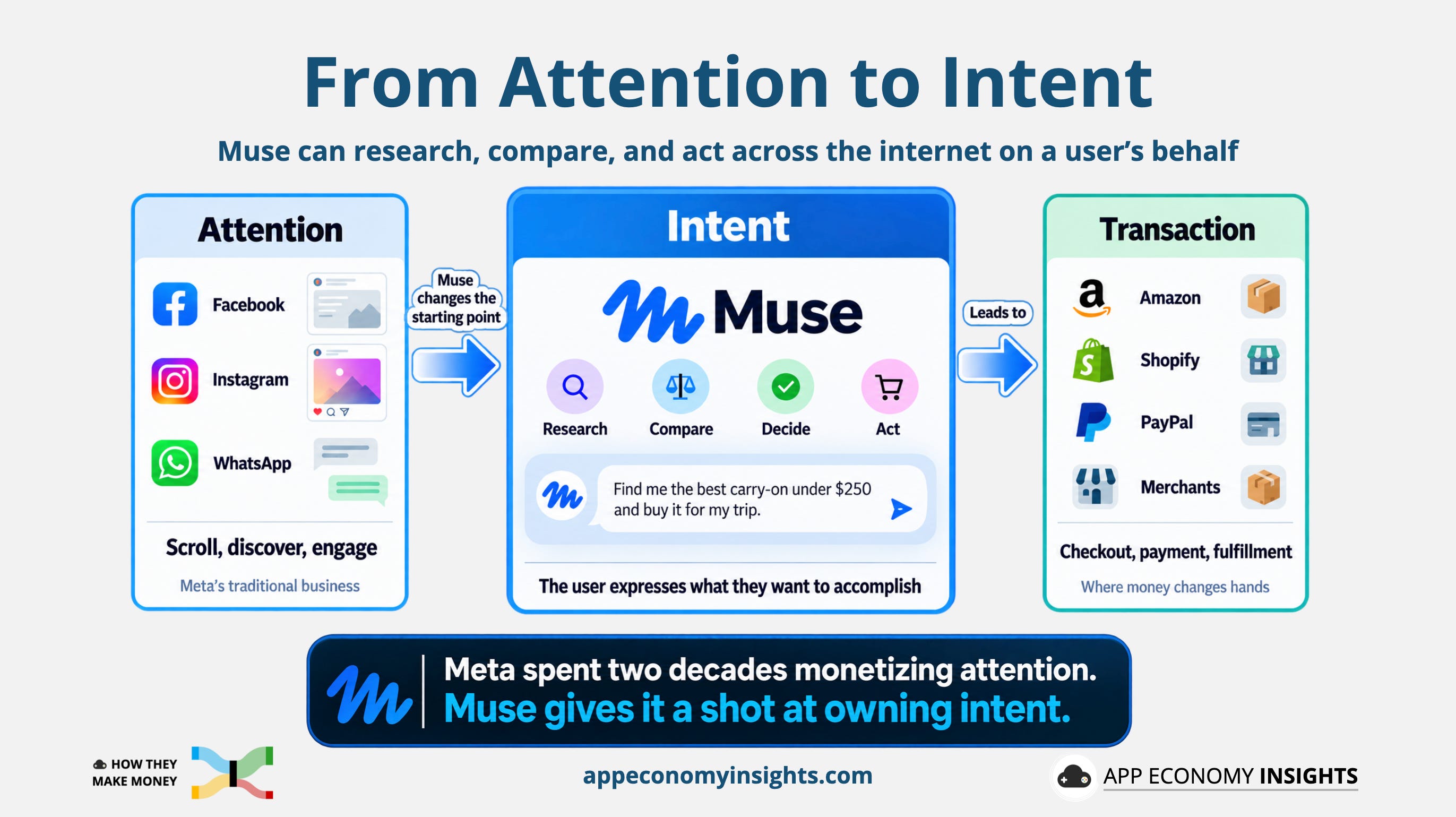
Meta is already pushing the idea further. Muse can place calls to businesses on your behalf, then return transcripts and summaries. It is coming to Meta’s AI glasses, potentially making the agent a persistent companion rather than an app you consciously open.
Then there is Instinct, which offers an even more interesting glimpse of where this may be heading. Instinct connects to email, messaging, your screen, audio, location and other signals. You can call or text it. Its ambition is not simply to respond when asked, but to understand what you are working on and what matters to you, notice threads you have dropped, proactively contact you, arrange a ride to the airport or book a handyman. That is a fundamentally different relationship with technology than anything that has come before.
For most of the digital era, humans operated software which served as input and output mechanisms with basic computational abilities. With copilots, software began advising humans. With personal agents, software knows, recommends, remembers and acts for humans and sometimes, even without their explicit permission.
This creates one of the strangest contradictions of the AI era. At the societal level, we are debating whether advanced AI development should slow down, whether recursive self-improvement should have hard limits and whether some capabilities are simply too dangerous to build. At the individual level, millions of us are effectively saying: read my email, understand my calendar, learn my preferences, remember what matters to me and start doing things on my behalf. I believe that very same contradiction is about to arrive inside every large company.
What relationship should an employee have with AI?
Most enterprises are still asking questions like: How many employees are using AI? How much time are they saving? Which models should we approve? What data can employees upload? How do we prevent bias, privacy violations or hallucinations? Those are necessary questions but they are no longer sufficient.
And adoption itself is rapidly becoming the less interesting question. Stanford’s 2026 AI Index found that 88% of surveyed organizations now use AI, while 70% use generative AI in at least one business function. Yet AI agent deployment remains in the single digits across almost every function. We are entering the period in which companies will decide not simply whether to use AI, but how much authority to give it.
The more important question may be what relationship do we want employees to have with machine intelligence? In fact, I believe it is becoming one of the defining questions for business leaders in the AI era.
Consider a marketer developing a new positioning strategy. One marketer studies the customer research, develops a hypothesis and asks AI to challenge the thinking, identify contradictory evidence and suggest alternative interpretations.
Another gives the research to an AI agent and asks it to determine the positioning, build the argument, write the presentation and recommend what the company should do. Both may be recorded internally as successful AI adoption. But the truth is that they are not remotely the same thing. In the first case, AI expands human judgment. In the second, human judgment is increasingly delegated to AI.
And this is already moving beyond simple task automation. Microsoft found that 49% of Copilot conversations support cognitive work such as analyzing information, solving problems, evaluating options and thinking creatively. AI is increasingly entering precisely the territory we have historically associated with professional judgment.
Now let’s extend that same logic across an organization. A media planner asks an agent to analyze performance. Then the agent recommends reallocating $100,000. Eventually, perhaps, it simply reallocates it. A customer service representative asks AI for suggested responses. Eventually the AI handles the customer directly. A financial analyst uses AI to interrogate a model. Eventually an agent builds the model, interprets the results and recommends the investment. A manager uses an AI coach to prepare for a difficult conversation. Eventually that same AI may know more about the manager’s weaknesses, relationships and decision patterns than anyone else in the organization.
The question shifts from “How should we use AI?” to “Which parts of cognition, judgment and action are we willing to delegate or give up?” This question has significant implications for how companies can compete today and in the future as well.
If every company has access to increasingly similar frontier intelligence, then the model itself becomes less differentiating. What becomes scarce is the intelligence surrounding it: proprietary customer knowledge, institutional memory, accumulated expertise, distinctive judgment and the ability to combine those assets with machine intelligence.
In other words, companies need to stop thinking only about their AI strategy and start thinking about their enterprise intelligence strategy.
This is one of the central questions we’ll be exploring at the AI Trailblazers Intelligence Summit in New York on September 29: what happens when intelligence itself becomes abundant, and how do organizations turn human, organizational, customer and machine intelligence into competitive advantage?
I think that requires at least five things.
Move beyond Responsible AI policies to understanding actual AI behavior.
Most companies have policies governing which tools employees can use and what data they can put into them. Far fewer understand how employees are actually working with AI. Organizations should begin studying AI engagement patterns. Where is AI being used to challenge human thinking? Where is judgment being delegated? Where are employees becoming dependent on it? Where are agents taking actions? Usage telemetry tells you whether AI is being adopted. It does not tell you what AI adoption is doing to the organization. My work with Fortune 500 companies is starting to help me understand the difference. And sometimes, the results are startling. In one organization, for example, we found that employees who would all be classified as active AI users were actually engaging with it in very different ways. Some were using AI to challenge and sharpen their own thinking. Others were delegating substantial parts of the thinking process itself. On an adoption dashboard, they looked identical. From an organizational intelligence perspective, they were anything but.Start defining human-reserved responsibilities.
We may eventually debate in society whether certain jobs should be legally reserved for human beings. Companies do not have to wait for that debate. They can start identifying decisions and responsibilities that should remain human-led. The need to make those choices may arrive faster than many leaders expect. In a 2026 Deloitte survey, only 5% of organizations said their business processes were highly prepared for AI agents, while 61% of executives expect most agents to be generally autonomous within four years, with humans providing oversight. Imagine an organizational chart that distinguishes not just people from AI agents, but responsibilities that are explicitly human-reserved. Hiring decisions. Terminations. Certain capital allocation decisions. Brand judgments. Ethical decisions. Accountability for consequential customer outcomes. The point isn’t to freeze today’s organization. It is to decide deliberately where human judgment remains institutionally important and where relying on AI creates a strategic advantage.Build an enterprise intelligence strategy.
Every company has accumulated intelligence that does not sit neatly inside a database: why a product decision was made, what customers really care about, why a campaign failed, what a salesperson knows about a market, which compromises produced a strategy and what experienced employees recognize instinctively. Companies need a systematic process for identifying this intelligence, capturing it, protecting it and deciding where AI should have access to it. In an era when models increasingly commoditize general knowledge, proprietary organizational intelligence may become one of the most valuable assets on the balance sheet, even if accounting rules never recognize it that way.Accelerate technical fluency alongside ethical fluency.
Responsible AI training cannot consist primarily of warnings about what employees shouldn’t do. People need to understand how these systems actually work: context windows, memory, agents, tool use, model limitations, permissions, retrieval, hallucination, evaluation and increasingly how autonomous systems make and execute decisions. Technical fluency makes ethical judgment more meaningful because people can understand what they are actually delegating. The goal should not simply be safer employees. It should be employees capable of exercising informed judgment over increasingly capable machines.Measure whether AI is making the organization more intelligent, not merely more productive.
Time saved is easy to measure but intelligence is much harder. Marketing and business leaders should start asking whether employees can explain why a recommendation is right, challenge an AI-generated conclusion, identify weak evidence, transfer learning to a new situation and make a decision when AI is unavailable. Productivity without retained judgment may be a very expensive form of efficiency.
The deepest AI question for business may therefore have very little to do with which model wins. It is about the relationship we choose to build with machine intelligence. We are creating systems that can increasingly know what we know, reason alongside us and act for us. The opportunity is enormous. So is the temptation to hand over more simply because we can.
The organizations that navigate this transition best may not be those that automate the most. They may be the ones that become most deliberate about what intelligence they give to machines, what intelligence they build with machines and what intelligence they refuse to give up.
Where I’ve been
One of the questions I explored at Marketing Vanguard during ADWEEK’s Brandweek Summit in Atlanta was what gives a CMO an edge when intelligence itself is becoming abundant. I don’t think the answer is simply how much AI a marketing organization uses. The more interesting question, and one I’m exploring through my research, is how people use it. Some direct AI to deepen their own expertise, others work with it iteratively and develop a new kind of human+AI collaboration skill, while increasingly some simply hand over the work. Those different modes have very different implications for productivity, learning, judgment and ultimately growth.


For CMOs, that means thinking beyond AI adoption and productivity metrics. We’ll need marketers with technical fluency in areas like AI evaluation, context design and agent orchestration, alongside the very human skills of judgment, creative courage, enterprise influence and human+AI leadership. The bigger question is not simply whether AI helps us produce more, but whether it helps us develop better marketers, make better decisions and build stronger organizations. It was also great seeing Cheryl Guerin, Rankin Carroll, Michael Ventura, Matt Kerbel, Natasha Madan, Tressie Lieberman, Tyler Stewart and Mishka Pitter-Armand, and especially Jenny Rooney, Liz Kneebone and the ADWEEK team.
What I’ve written lately
The AI Future We Are Paying For (September 2026)
Why Isn’t AI in the P&L? (September 2026)
The AI Advantage Is Faster Decisions (August 2026)
Companies Are Missing the Point of AI (August 2026)
Taste Is No Longer a Human Advantage (July 2026)
Shiv Singh is the CEO of Savvy Matters, which helps business teams translate AI disruption into practical business and marketing strategies, organizational design, executive-ready roadmaps, and bespoke education programs. He is also the Co-Founder of AI Trailblazers, a vibrant community uniting marketers, technologists, entrepreneurs, and venture capitalists at the forefront of AI.
A former two-time Chief Marketing & Customer Experience Officer and author of Marketing with AI for Dummies (4th print run, translated into five languages), Shiv built his career at LendingTree, Visa, PepsiCo, and The Expedia Group, and serves as a public-company board member of a Fortune 300 company and private investor.