
The Front Door Moves
Brands spent twenty-five years winning clicks. Now they must provide answers.


Before the main story, here are some signals that point in the same direction.
Google AI Mode has crossed one billion monthly active users, with query volume doubling every quarter since launch. Adobe’s 2025 holiday data found that AI-referred visitors converted 31% better than other traffic sources. The behavior shift is real, and the economics are already following. More from Google.
AI visibility is becoming the new search visibility. The New York Times argues that marketers are moving from a world built around clicks to one shaped by how ChatGPT, Gemini, Claude and Google AI Mode describe, cite and recommend brands. I was quoted in this piece saying this shift in discoverability is “like an earthquake nobody expected.” More from The New York Times.
ChatGPT ads are enabling competitor conquesting inside the answer itself -a brand dilemma that didn’t exist six months ago. A user can receive an organic answer that mentions your brand favorably, then see a competitor’s paid placement in the same breath. OpenAI’s “Answer Independence” principle means ads don’t change the organic response. But they do occupy the moment around it. More from Ad Age.
Publishers are sharing what happens when answers replace clicks. People Inc. has said Google represented 75% of its traffic four years ago and is now closer to 25%. USA Today has raised the possibility of blocking Google entirely if AI summary usage doesn’t come with meaningful economic return. The early warning system is flashing. More from Axios.
Taken together, these stories point to the same underlying shift. AI is no longer just changing the tools marketers use. It is becoming the interface between consumers and brands, fundamentally changing how discovery, consideration, and competition work.
Being Found Is No Longer Enough
One of the stranger moments for me at the Cannes Creativity Festival this year was watching Anthropic’s Claude win for a Super Bowl campaign that poked fun at advertising inside AI. The work was sharp and beautifully executed, a direct shot at OpenAI’s move toward advertising in ChatGPT. As a signal, it was more complicated. It was, in effect, an ad arguing that AI conversations should not carry ads, made by an impressive company whose immense momentum comes from developer tools and not from consumer adoption. It also raised a much bigger question. What role will AI, and advertising within it, ultimately play in how consumers discover brands, evaluate products, and make purchase decisions?
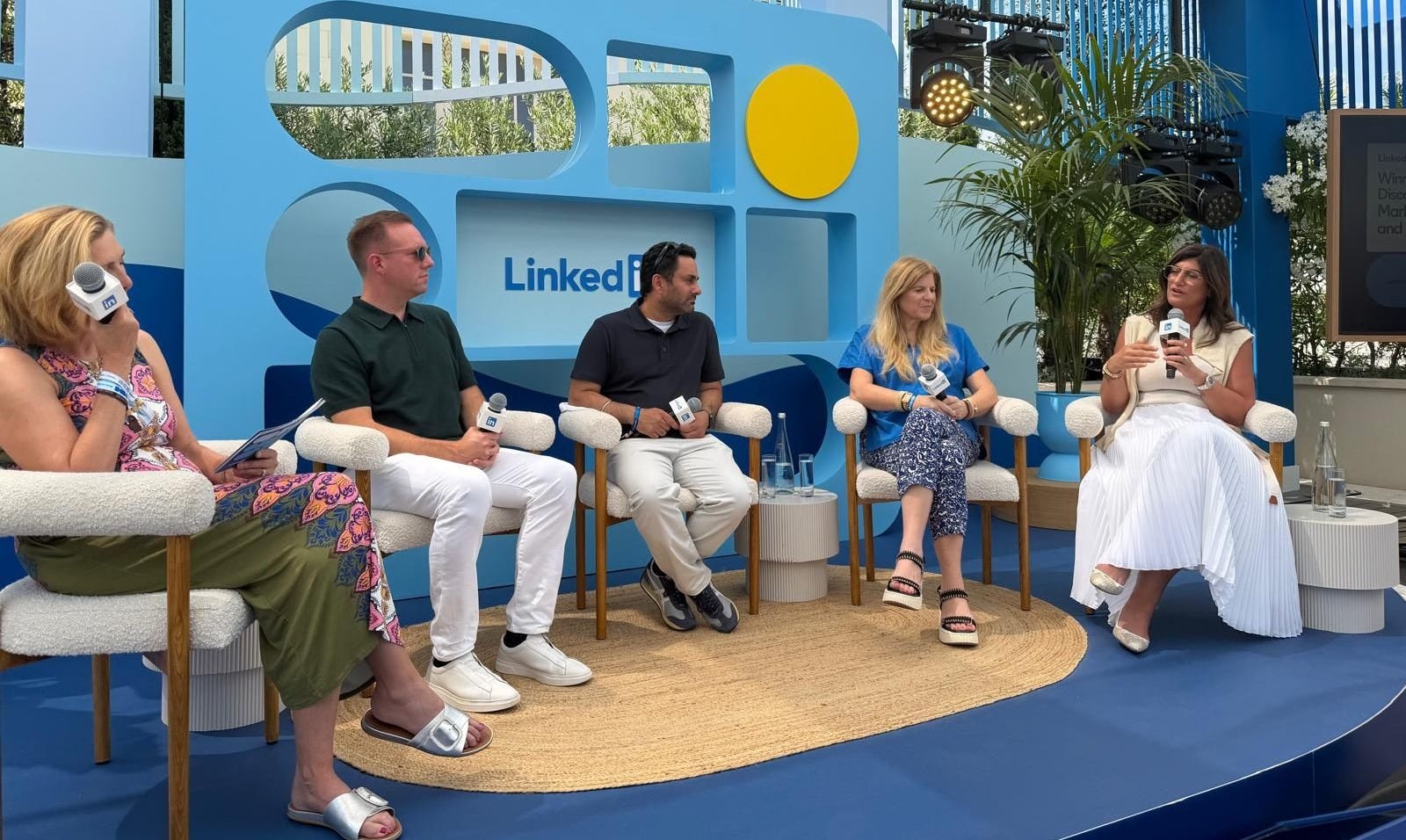
It was one of the themes that emerged during a LinkedIn panel I joined alongside Lorraine Twohill, CMO of Google; Jessica Jensen, CMO of LinkedIn; Carla Hassan, CMO of JPMorganChase; and Colin Fleming, CMO of OpenAI Business. A company that built the original front door to the internet. A company helping build the next one. A network whose value rests on professional identity and reputation. And a bank whose entire product, underneath the accounts and the apps, is trust. Four very different businesses wrestling with the same question. That alone told me this is not a story about better ads. It is a structural shift in how people find, judge, and choose.
Cannes was full of AI conversation but not always enough AI curiosity. There were opinions everywhere, but far fewer people were willing to engage deeply with the technology as it stands today, let alone where it may be in twelve months. Too many conversations still described generative AI from a year ago, or circled familiar tropes about creativity and efficiency, when the more consequential change is happening underneath the surface of the internet itself.
There were exceptions. The most useful came from Amazon Web Services, where the conversation was not about AI as theater but about rebuilding the marketing function from the ground up. Julia White, the Amazon Web Services CMO, asked her teams to name the paper cuts in their jobs, the mechanics they would happily never do again, then built agent-native processes to absorb them. One web page publishing workflow reportedly went from four hours of thankless work to ten minutes. The reaction was not fear of replacement. It was applause. That is the specificity the industry needs now; evidence of where AI is changing the operating model of a marketing function itself, not broad claims about transformation.
That points to a larger question around not just where AI is heading, but what it may already be. There was little curiosity about whether these systems could be developing something like taste, judgment, or cultural fluency. The reflex is to insist they cannot, that they only predict the next token. AI does not need to replicate the human brain to matter here. It only has to mimic the human mind well enough to influence decisions, and with the right inputs, weights, and temperature, it may close that gap faster than most marketers and creative leaders at Cannes seemed ready to admit. For example, I increasingly find AI identifying which arguments resonate, where my reasoning is weakest, and which sections best match my voice in my own writing. If a model can begin to recognize individual taste in writing, it is not a big leap to one that helps shape what taste looks like for a brand, a category, or even a culture.
From Winning Attention to Influencing a Model
The bigger story is not whether AI can make ads or accelerate a workflow. That matters, but it is not the deepest change. The deepest change is that large language models are becoming the new front door to consumer decisions.
For twenty-five years, digital marketing ran on a simple pattern. Consumers searched, links appeared, and brands fought to win the click. The click mattered because it moved the consumer into an environment the brand controlled, where it could explain itself, persuade, convert, and measure.
That contract is weakening. When a consumer asks ChatGPT, Gemini, Claude, Perplexity, or Google’s AI Mode what to buy or whom to trust, the brand no longer gets the first word. The model does. It synthesizes product information, reviews, sentiment, pricing, and expert opinion before it answers. The first meaningful impression of a brand may no longer come from its own site or its own advertising. It may come from what a model has concluded the internet says about it.
That changes the work. Search optimization was about visibility. Answer optimization is about interpretation. A brand has to be understood accurately, described favorably, compared fairly, and recommended credibly by systems that do not respect the boundaries of the org chart or the aspirations of the brand manager. Owned content still matters, but so do reviews, expert analysis, retailer pages, creator endorsements, paid advertising, Reddit forum opinions, and the consistency of every claim across all of them. The machine is not asking which department of a company produced the signal. It is asking whether the signal is clear, current, credible, and reinforced everywhere it looks.
The Paid Moment Around the Answer
Here the Anthropic example becomes useful again, as a picture of the gap between advertising as cultural theater and advertising as business strategy. The Claude campaign made a clever point about ads in AI conversations and maybe, it was a point that resonated with its core customer. Meanwhile OpenAI was using Cannes to make the case for the commercial value of ChatGPT itself. If ChatGPT is already where consumers research products, weigh alternatives, and decide, then advertising inside it is not just another media format. It is advertising inside the decision layer.
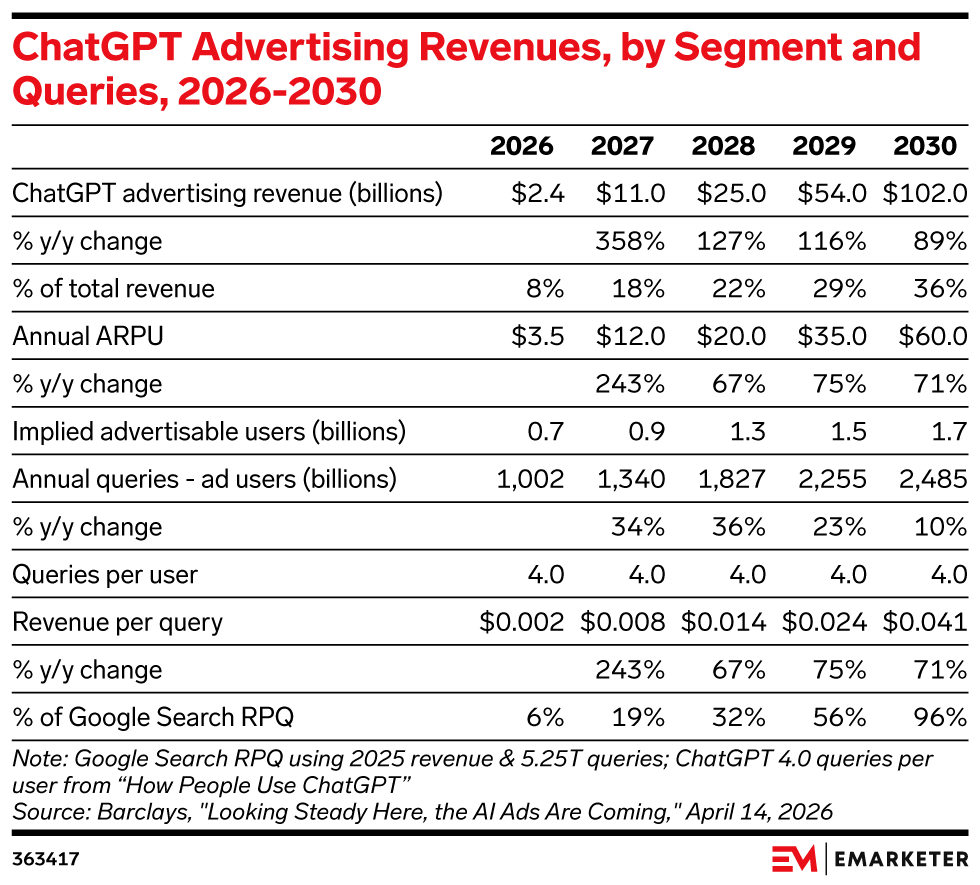
The pattern is already visible. Brands are seeing rivals buy sponsored placements around the very prompts where they win the organic recommendation. A brand might surface organically in a response about whether its product is worth the subscription, only to have a competitor appear beside that answer with a paid alternative. Adthena found that for direct comparison queries between two named brands, a third-party ad appeared 86 percent of the time. That is not passive advertising. It is conquesting at the moment of evaluation, where the user has already revealed need, context, and intent.
That makes AI advertising different from search. The consumer is further along, describing a problem and waiting for a recommendation fitted to their situation, so the model holds more context and the ad sits closer to the moment a decision forms.
So a new problem appears. It is no longer enough to win the organic answer; you have to defend the paid moment around it. The trust a brand earns through product quality, experience, and answer visibility can become the audience a competitor buys access to. Paid and organic can no longer run as separate disciplines. The old logic of winning organic to reduce paid dependency breaks when a competitor can buy into the exact context your credibility created.
Which Makes It, Finally, a Trust Question
Sit with all of that and the deepest layer reveals itself. This is not ultimately about channels or formats. During our panel, particularly as Carla Hassan spoke about trust, I found myself thinking about it on three levels.
The first is whether the model trusts the brand enough to recommend it. That trust is earned across the entire public record, not within a single campaign, and assembled by a system the brand neither controls nor can fully see.
The second is whether the consumer trusts the model. As people become more comfortable accepting synthesized answers, authority shifts from the brand to the intermediary. Brands used to earn trust directly. Increasingly, they earn it through a model’s interpretation of what everyone else says about them.
The third is the vulnerability that shift creates. Earned trust becomes a targetable asset. The credibility a brand has spent years building can become the very audience a competitor pays to intercept with advertising.
This is why a bank belonged on that panel every bit as much as a search company or an AI behemoth. For an institution whose business is built on trust, an interface that determines who gets recommended, and on what evidence, is close to an existential question. It also points to the harder creative challenge. The work is to make brand meaning legible to machines without draining what makes it compelling to people. Optimize too heavily for readability and the machine can parse the content while the human has little interest in experiencing it. Optimize only for emotion and the machine lacks the evidence it needs to understand and recommend the brand. The best companies will do both. They will create rich human experiences that build memory and emotion while also creating structured evidence that helps AI systems read what the brand does and why it deserves to be trusted. That does not make marketing less creative. It makes it more demanding.
This is the conversation the industry should be having. The biggest question is not whether AI makes a better ad. It is what happens when AI becomes the interface between brands and their customers, because once that interface changes, the entire marketing system changes with it. The front door is moving from search results to synthesized answers, from clicks to conversations, and from ranking for keywords to being understood, trusted, recommended, and defended within the answer itself. This is not SEO with a new acronym or media buying with a conversational wrapper. It is a fundamental shift in how people discover, evaluate, and decide, and in who they trust to help them do it. The brands that win will recognize that marketing now has two audiences at once: people, and the machines increasingly standing between people and their decisions.
Where I’ve been
Earlier in June, I spoke at the Financial Times Outstanding Directors Exchange on “AI and the Modern Director.” The boardroom conversation has clearly moved beyond experimentation to governance, talent strategy, and competitive advantage.


It was a pleasure to represent United Rentals as a long-time board member alongside Sonita Lontoh and Thaddeus Malik, with Anna Bianca Roach of the Financial Times moderating. We discussed AI education, how directors should evaluate AI claims, the new skills boards need, and how companies can move at the speed of the exponential while managing the costs of token maximization.
The bigger question is not simply how boards oversee AI. It is how they help management teams build the judgment and operating muscle to compete as the execution layer rapidly changes.
AI is reshaping expertise, workflows, talent, cost structures, and the balance between human judgment and machine speed. That makes the director’s role more important than ever.
What I’ve written lately
The Execution Layer is Collapsing (June 2026)
The End of the Segment (May 2026)
When Intelligence Enters the Org Chart (May 2026)
A Public Company Goes All In on AI (April 2026)
Shiv Singh is the CEO of Savvy Matters, which helps business teams translate AI disruption into practical business and marketing strategies, organizational design, executive-ready roadmaps, and bespoke education programs. He is also the Co-Founder of AI Trailblazers, a vibrant community uniting marketers, technologists, entrepreneurs, and venture capitalists at the forefront of AI.
A former two-time Chief Marketing & Customer Experience Officer and author of Marketing with AI for Dummies (4th print run, translated into five languages), Shiv built his career at LendingTree, Visa, PepsiCo, and The Expedia Group, and serves as a public-company board member of a Fortune 300 company and private investor.