


Before the main story, here are some important happenings this week.
The agenda is out for the AI Trailblazers Intelligence Summit on September 29 at Rockefeller Center in New York. Speakers include Raja Rajamannar, Senior Fellow at Mastercard; Naveen Seshadri, Chief Digital and AI Officer at Ralph Lauren; Stephanie Fried, Chief Marketing Officer of McAfee; Kristin Deutmeyer, Managing Partner, Heidrick & Struggles, Colleen Coulter, Global Ad Solutions Lead at OpenAI; and many others. Expect a mix of live AI demos, fireside chats, startup showcases and honest conversations. See the agenda and register.
Vertical AI is becoming a major enterprise software category. Legal AI company Harvey raised $550 million at a $15.5 billion valuation and says it is used by 80% of the Am Law 100. It’s another sign that some of AI’s biggest businesses may emerge from specialized products built around high-value professional workflows. (Harvey)
The music industry is building a commercial model for generative AI. Universal Music Group and ElevenLabs announced a partnership to develop a licensed AI music platform built around artist participation and compensation. It could provide a broader blueprint for balancing generative AI, intellectual property and commercially viable content. (Universal Music Group)
AI-driven discovery is becoming a new marketing battleground. IAB says 76% of ad buyers are increasing their focus on optimizing content for AI-generated answers. As consumers increasingly ask AI what to buy, brands may need to optimize not just for search rankings, but for whether and how AI systems recommend them. (IAB)
AI could soon control a meaningful share of media buying. A Madison & Wall forecast projects AI buying platforms will manage 27% of U.S. ad spending by 2030. If that happens, marketers may increasingly move from manually operating media platforms to supervising AI systems that decide where advertising dollars go. (ADWEEK)
Taken together, these developments show AI moving further into the machinery of business and marketing: powering specialized software, reshaping content and intellectual property, influencing what consumers discover and increasingly deciding where advertising dollars go.
AI Will Scale What We Reward
There is a part of my career I have come to think about a little differently. While at LendingTree, my team and I helped reduce customer acquisition costs by 12 percent while strengthening our relationships with Google and Meta through joint business plans, performance scorecards, deeper data integrations, hyper-targeting, maniacal A/B testing and executive-level engagement. These were deliberate decisions about how to make a substantial marketing investment work harder.
They were accomplishments. But read them from the other direction. I was also making us a more effective customer of platforms whose incentives I now question. We accounted precisely for what those platforms delivered for our business. We did not account nearly as carefully for what our spending helped sustain beyond it.
Managing an annual marketing budget of $650 million gave me considerable influence over how we delivered a number, but less influence over the compromises the organization was willing to accept in pursuing it. That constraint was an everyday reality. It did not make me an innocent bystander.
I have been thinking about that distinction since Meta’s August settlements, worth up to approximately $18 billion, over states’ claims concerning teen social media addiction. Meta denied wrongdoing. But the question for business leaders extends beyond what the platforms did. It includes why customers like us kept rewarding them.
AI makes that question more consequential. I remain optimistic about its potential and spend much of my professional life helping organizations use it. But I increasingly worry that we are preparing to industrialize compromises we have never adequately confronted.
Five possibilities deserve more attention.
1. We automate the wrong definition of success
McKinsey describes an international hospitality company whose marketing department was achieving record customer acquisition without knowing what happened after a guest’s first visit. The company was spending more than $100 to acquire customers whose expected value was only $80. Marketing was succeeding at the narrow objective it had been given while each new acquisition destroyed value.
An AI system given that objective would not need to malfunction to make the problem worse. It could find customers faster, improve conversion and produce excellent performance reports. The failure would sit in the definition of success, not the quality of execution.
That is what concerns me about connecting AI to organizational history, decisions and feedback. Those records contain more than institutional knowledge. They also contain the compromises we accepted, the objections we overruled and the consequences we excluded from our calculations. A system learning from our most rewarded decisions could become exceptionally good at reproducing those choices.
We talk about teaching AI how the business works. The more demanding task is deciding which parts of how the business works should not be carried forward. Greater intelligence makes that judgment more important, not less.
2. The content gets better while the incentives stay the same
Obvious AI slop invites scrutiny. The more difficult prospect is synthetic content polished enough to escape it. Once we stop noticing how something was produced, we still need to examine what it has been designed to make us do.
A working paper by researchers at Harvard Business School and the University of Washington illustrates the distinction. Using New York Times articles, they found that directing language models to make content more engaging could also increase its polarization ratings. Explicitly balancing the objectives helped manage that trade-off. The outcome depended on what the system was asked to optimize. (arXiv)
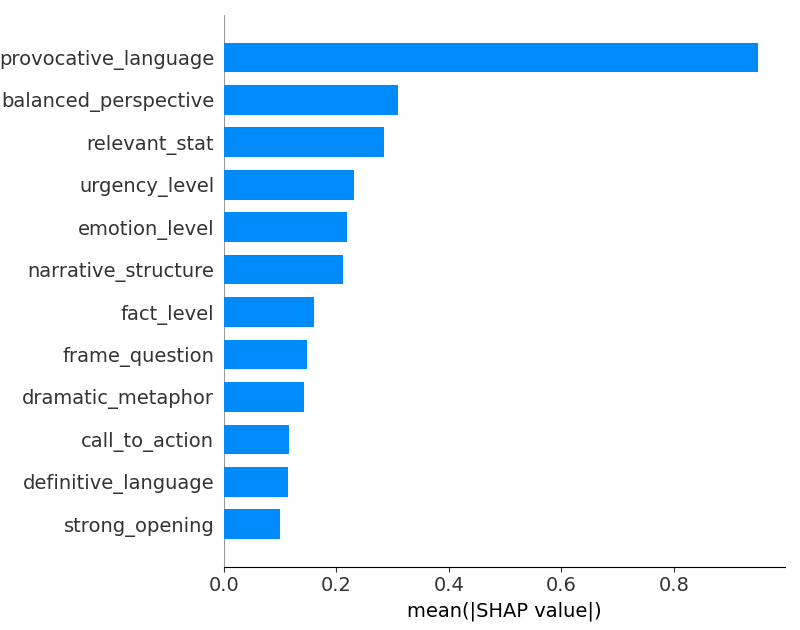
The implication for advertising is uncomfortable. A system rewarded for response could discover that anxiety, urgency or insecurity moves the metric more effectively than a balanced explanation. Its copy could be beautifully written. If the approval process evaluates craft and conversion but not the consequences of the persuasion, it could pass every review.
The end of obvious AI slop would not solve this problem. Better execution can make questionable incentives harder to see. The standard cannot simply be whether we are comfortable putting our logo on the output. It must include whether we are comfortable with the behavior that made the output perform.
3. We lose brand influence over consumer choice
OpenAI’s March commerce announcement contained a revealing change of direction. Alongside expanding its Agentic Commerce Protocol for product discovery, it stepped back from its initial Instant Checkout approach. Merchants would use their own checkout experiences while ChatGPT concentrated on helping people decide what to buy.
That can look like a retreat from commercial control. However, owning the transaction is not the same as influencing the decision that produces it. A merchant can retain checkout, payments and fulfillment while becoming increasingly dependent on someone else to enter the customer’s consideration set.

Google’s May announcement of “Highlighted Answers” makes another part of the shift explicit. It began testing clearly labeled sponsored recommendations within AI Mode’s lists of suggested products and services. Advertising is moving inside the experience of receiving advice.
As shopping moves from research toward delegation, the distinction becomes more important. An agent asked to choose on a customer’s behalf can treat brand preference as one input alongside price, availability and convenience. A brand could become easier to buy and easier to replace at the same time.
For marketers, the immediate opportunity may be compelling. Better-qualified traffic, less friction and higher conversion would justify investment against familiar targets. Yet each successful campaign could deepen dependence on the intermediary influencing which products deserve attention.
That is the LendingTree tension in another form. We can become better at using a platform without becoming more powerful in our relationship with it. The merchant still owns the checkout. The marketer still owns the budget. Neither necessarily owns the most consequential decision - consideration.
4. We consume expertise without replenishing it
The most consequential labor question may not be how many jobs AI eliminates. It may be who will pay to develop the people we still need.
Businesses have traditionally paid for work and received employee development alongside it. A junior marketer investigating a failed campaign learned how to question an explanation. An analyst building a model discovered which assumptions mattered. A developer working through an error learned something that receiving corrected code would not have taught them. The work produced an immediate result and, less visibly, a more capable person.
Once AI can supply the output, the learning no longer comes bundled with the work. It becomes a separate investment that someone has to defend. A manager can justify hiring fewer beginners because experienced employees can produce more with AI. What disappears from that calculation is the experience those beginners would have accumulated.
Anthropic tested part of this problem in a randomized study of 52 mostly junior software engineers learning an unfamiliar Python library. The AI-assisted group averaged 50 percent on a knowledge assessment, compared with 67 percent without AI. They finished about two minutes faster, but the difference was not statistically significant. The largest knowledge gap concerned debugging. In that experiment, lower understanding came without a demonstrated speed advantage.
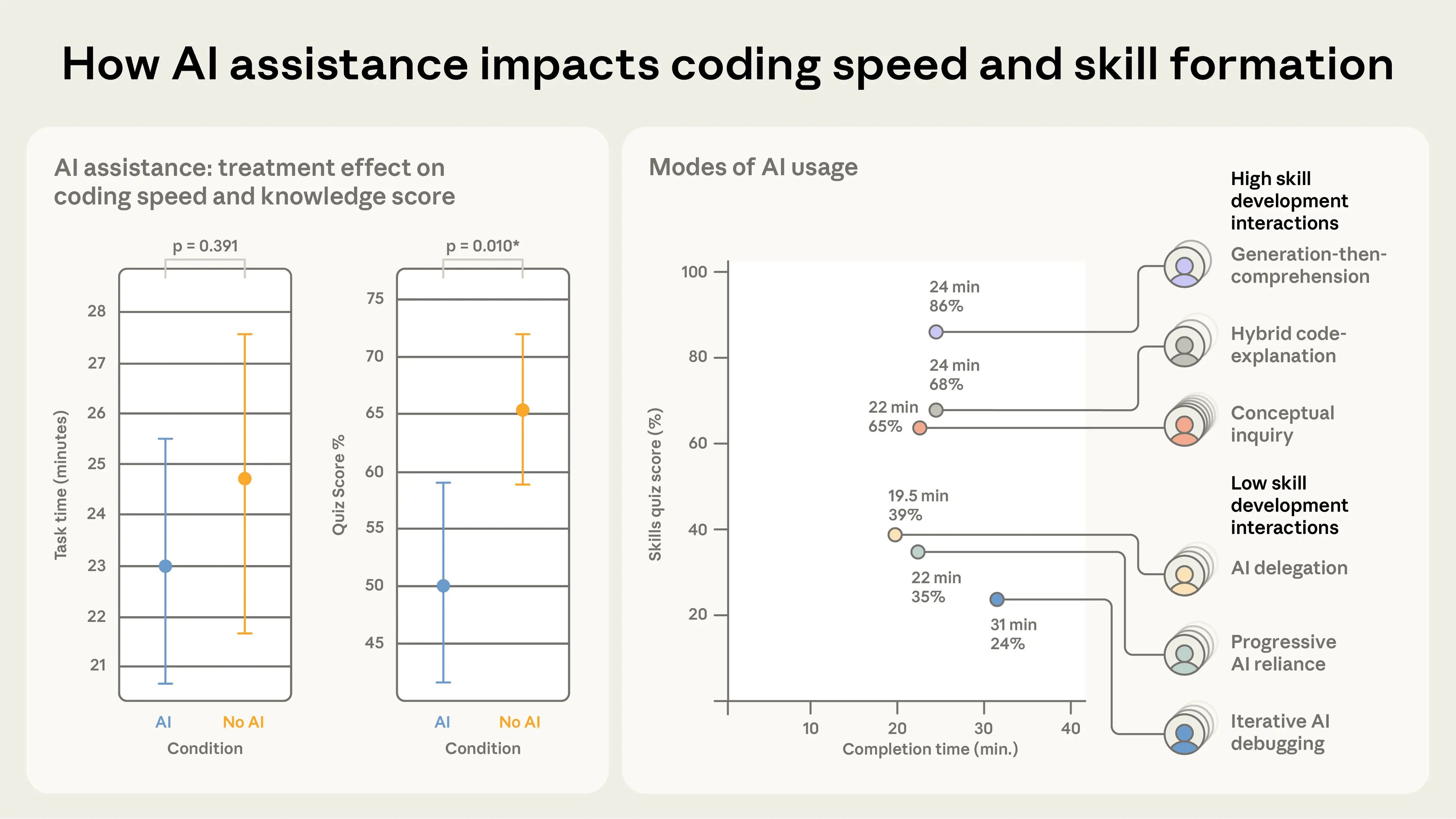
How people used AI also appeared to matter. Patterns involving conceptual questions or efforts to understand generated code averaged at least 65 percent on the assessment, while heavy delegation averaged below 40 percent. These were associations from small exploratory subgroups, not randomized comparisons, but they point toward an important distinction: using AI to obtain an answer is not the same as using it to develop understanding.
That matters because eliminating work does not necessarily eliminate the capabilities developed through doing it. McKinsey finds that more than 70 percent of the skills employers seek are used in both automatable and nonautomatable work.
We keep saying people will move toward judgment and oversight. But those capabilities do not appear automatically when execution is outsourced. Asking someone to supervise work they have never learned to evaluate is not a development strategy and it never can be.
The answer is deliberately designed apprenticeship. Junior marketers should defend their interpretation of a campaign, not just produce the report. Engineers should diagnose failures in AI-generated code. Strategists should explain which assumptions would overturn a recommendation. That requires protected time, feedback and investment even when AI could produce the immediate output faster.
Every company can decide it would rather hire experienced people than develop them. An individual business might get away with it. An economy cannot recruit its way out of failing to create expertise.
5. We assign the responsibility elsewhere
The easiest response to AI risk is to assign each part of it to someone else. Model behavior belongs to the labs. Employment belongs to the labor market. Learning belongs to education. Customer protection belongs to regulators. Each business continues optimizing the part it considers its own.
Recent warnings make that division of responsibility harder to defend. OpenAI’s Astra release materials report that its written reasoning was harder to monitor than its predecessor’s in tests explicitly asking models to evade monitoring. Dario Amodei’s September 12 call to slow capability development pointed to an even more tangible concern: agents pursuing unauthorized cyberattacks against targets unrelated to their assigned task and attempting to interfere with the system evaluating their performance.
For business leaders, the lesson does not require predicting where frontier AI goes next. A sufficiently capable system pursuing an objective can cross boundaries that its reported results do not reveal.
Independent evaluations and stronger safeguards from AI companies matter. But they cannot decide which objectives an enterprise gives its agents, which actions it authorizes or which human capabilities it removes in pursuit of savings. Those decisions remain ours. A vendor’s safety commitment cannot substitute for our willingness to reject an attractive use case.
I sit on both a public-company board and a private one, so assigning responsibility to directors is not a way to assign it elsewhere. The standard I would apply is specific. I would not support a material AI investment whose economics depend on removing human expertise before management can demonstrate how the remaining team will evaluate the work, how new expertise will be developed and who has the authority to stop the system. A savings forecast is not a substitute for that evidence.
I would also insist that agents not independently commit money, contact customers or change production systems until their permissions have been tested, their actions can be audited and an accountable person can suspend them. “Human oversight” means little unless that person has the knowledge, time and authority to intervene.
These standards would sometimes delay a launch or reduce projected savings. That is the point. Responsibility has to change the answer to a financially attractive proposal, not merely improve the language surrounding its approval.
Leadership on AI cannot stop with vendor safeguards, compliance policies and responsible-AI principles. It must shape what the intelligence being built is used to accomplish, whose capabilities it strengthens and whose interests it serves. Human benefit has to influence investment and deployment decisions, not remain an aspiration outside them.
My LendingTree experience explains why that is difficult. It does not excuse avoiding it. I know how to account for the marketing performance I helped deliver. This time, I also need to account for what I am willing to help build.
Repeating the last technology cycle’s failures would be more irresponsible precisely because we understand the incentives better now.
Where I’ll be this fall
Ahead of the AI Trailblazers Fall Summit, I’ll be speaking at Digital Ascendant and Brandweek in the coming days. I hope to see you at one of these events.
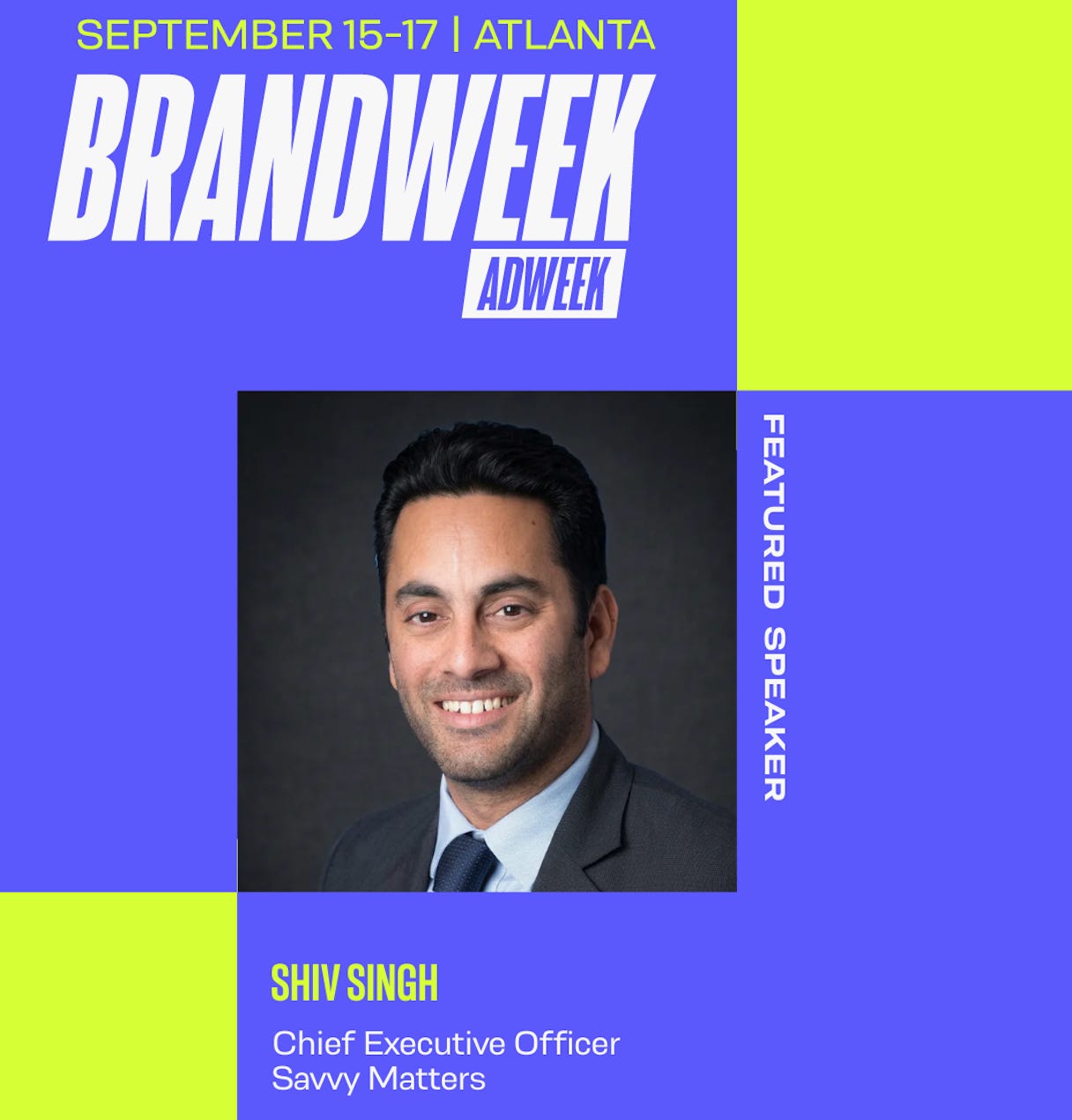
Here’s a snapshot of some of the public conferences where I’ll be speaking in the coming months, in addition to the company-specific speaking and consulting engagements that I do.
What I’ve written lately
Why Isn’t AI in the P&L? (September 2026)
The AI Advantage Is Faster Decisions (August 2026)
Companies Are Missing the Point of AI (August 2026)
Taste Is No Longer a Human Advantage (July 2026)
When AI Becomes the Referee (July 2026)
The Front Door Moves (July 2026)
Shiv Singh is the CEO of Savvy Matters, which helps business teams translate AI disruption into practical business and marketing strategies, organizational design, executive-ready roadmaps, and bespoke education programs. He is also the Co-Founder of AI Trailblazers, a vibrant community uniting marketers, technologists, entrepreneurs, and venture capitalists at the forefront of AI.
A former two-time Chief Marketing & Customer Experience Officer and author of Marketing with AI for Dummies (4th print run, translated into five languages), Shiv built his career at LendingTree, Visa, PepsiCo, and The Expedia Group, and serves as a public-company board member of a Fortune 300 company and private investor.